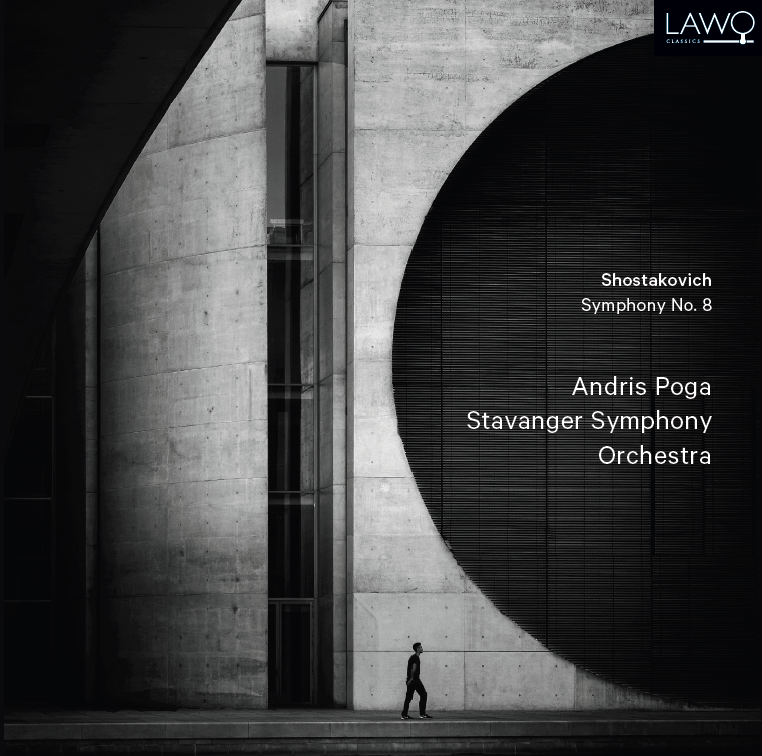
At a time marked by war, conflict and increasing pressure on individual freedom, Stavanger Symphony Orchestra releases Dmitri Shostakovich’s Symphony No. 8, conducted by former Chief Conductor Andris Poga.
“This is music that challenges us, but also opens new horizons for artistic expression and depth,” says Andris Poga.
Dmitri Shostakovich’s Symphony No. 8 is one of the most intense and uncompromising orchestral works of the 20th century. Written in 1943, in the midst of the Second World War, it is a nearly hour-long musical journey through grief, suffering, chaos and loss. Shostakovich himself referred to his Seventh and Eighth Symphonies as his “requiems” – works for those who died and suffered.
For Stavanger Symphony Orchestra, the encounter between the individual human being and the great forces of society has been at the heart of the recording.
“The reason we wanted to record Shostakovich’s Symphony No. 8 was a desire to focus on the struggle between the fragile and vulnerable human being and the great, powerful and often dark forces in society that create war and conflict. This was a reality in Shostakovich’s life and in the society around him, and it is also a reality in our own time,” says Ilmari Hopkins, Chair of the Programme Committee at Stavanger Symphony Orchestra.
Shostakovich’s life and work were shaped by a complex relationship with the Soviet authorities. Under Stalin, composers were expected to create music that aligned with the regime’s worldview, while Shostakovich himself experienced intense political pressure and criticism. His Eighth Symphony was initially met with scepticism and was later condemned by the regime for its pessimism and complexity. The work was not performed again in the Soviet Union until after Stalin’s death.
A requiem for those who suffered
The symphony was written in the shadow of war, but at the same time offers a broader reflection on human suffering. Shostakovich described how the war opened up a space in which grief and pain could be expressed – emotions that otherwise had to remain hidden. In retrospect, the Eighth Symphony has therefore come to be understood both as a testimony to its own time and as a work of broader, universal significance.
The music unfolds across five movements, shifting between violent energy, grotesque and mechanical passages, silence and resignation. The final movement moves towards C major and suggests a glimpse of peace, but without the triumphant resolution found in many other symphonic works. Hope remains fragile and ambiguous.
“The symphony has a dark, grey and profound underlying character. There are small glimpses of hope and light, but they do not last long. We want to touch people and awaken important thoughts,” says Ilmari Hopkins.
“The music may be more relevant than ever”
Andris Poga was Chief Conductor of Stavanger Symphony Orchestra from 2021 to 2026 and worked closely with the orchestra throughout his tenure. He describes Shostakovich’s Eighth as an example of how great works of art can emerge from turbulent times.
“The greatest masterpieces in music history have often been created in the most turbulent of times. Shostakovich’s Eighth Symphony is one of the clearest examples.”
Poga also highlights the particular sensitivity composers can have to the world around them, and how Shostakovich transformed the people and events of his time into a deeply personal musical language.
“But this is not simply a historical document. The music may be more relevant than ever. It challenges us and takes us out of our comfort zone, while at the same time opening new horizons of artistic expression and depth. I sincerely hope that our work to bring Shostakovich’s musical visions to life will move those who listen.”
Recorded at Stavanger Concert Hall
The recording was made at Stavanger Concert Hall on 26–28 and 30 May 2025, with Vegard Landaas as producer and editor, and Thomas Wolden responsible for sound engineering and mastering. The album is released by the Norwegian record label LAWO Classics.
For Stavanger Symphony Orchestra, the release forms part of the orchestra’s extensive recording history and international artistic activity. Founded in 1938, the orchestra today comprises 85 musicians representing 22 nationalities and has, over several decades, built a significant catalogue of recordings with a range of record labels.
Shostakovich: Symphony No. 8
Dmitri Shostakovich (1906–1975) Stavanger Symphony Orchestra Andris Poga, conductor LAWO Classics – LWC1473